
Paint applied by electrodeposition. A controlled power supply ensures a uniform film and excellent coverage of complex parts.
Micronics Systems designs rectifiers suited to this process: controlled voltage, reliable current and sustained performance, even on the most demanding lines.
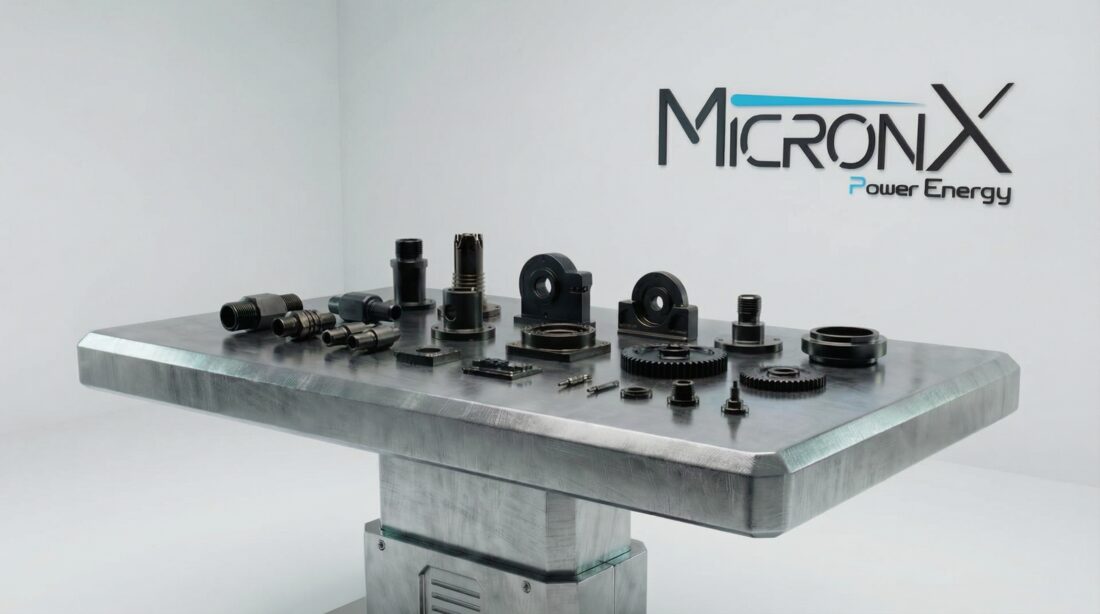
Cathodic e-coating is a process of paint applied by electrodeposition. The part, immersed in a water-based paint bath, is connected as the cathode : under direct current, the paint particles migrate and deposit evenly over its entire surface.
Its great strength isuniformity : the film forms everywhere, including in recesses, hollow sections and hard-to-reach areas — precisely where sprayed paint would leave gaps. The resulting coating, usually black, offers excellent corrosion protection.
That is why cathodic e-coating is used extensively in theautomobile industry and in general manufacturing for structural and underbody parts. The process works by a controlled voltage ramp : it is the applied voltage that governs the thickness and consistency of the film.
Degreasing and phosphating to prepare the surface for the film.
The part is immersed in the paint bath and connected as the cathode.
The voltage makes the paint migrate; the film deposits uniformly.
Oven curing to polymerise and harden the coating.
There is no cathodic e-coating at all without direct current: the comparison is about the quality of that power, between a supply that fluctuates and a regulated rectifier.
In cathodic e-coating, the thickness and uniformity of the film depend directly on the applied voltage and on the way it ramps up. Poorly controlled voltage means a film that is too thin, too thick or uneven — putting corrosion protection at risk.
Micronics rectifiers provide precise voltage and controlled ramp-ups, for an even coating on every part, including complex geometries. A key advantage on high-throughput automotive lines, where consistency is what quality is made of.
Our experts support you from study through to commissioning.